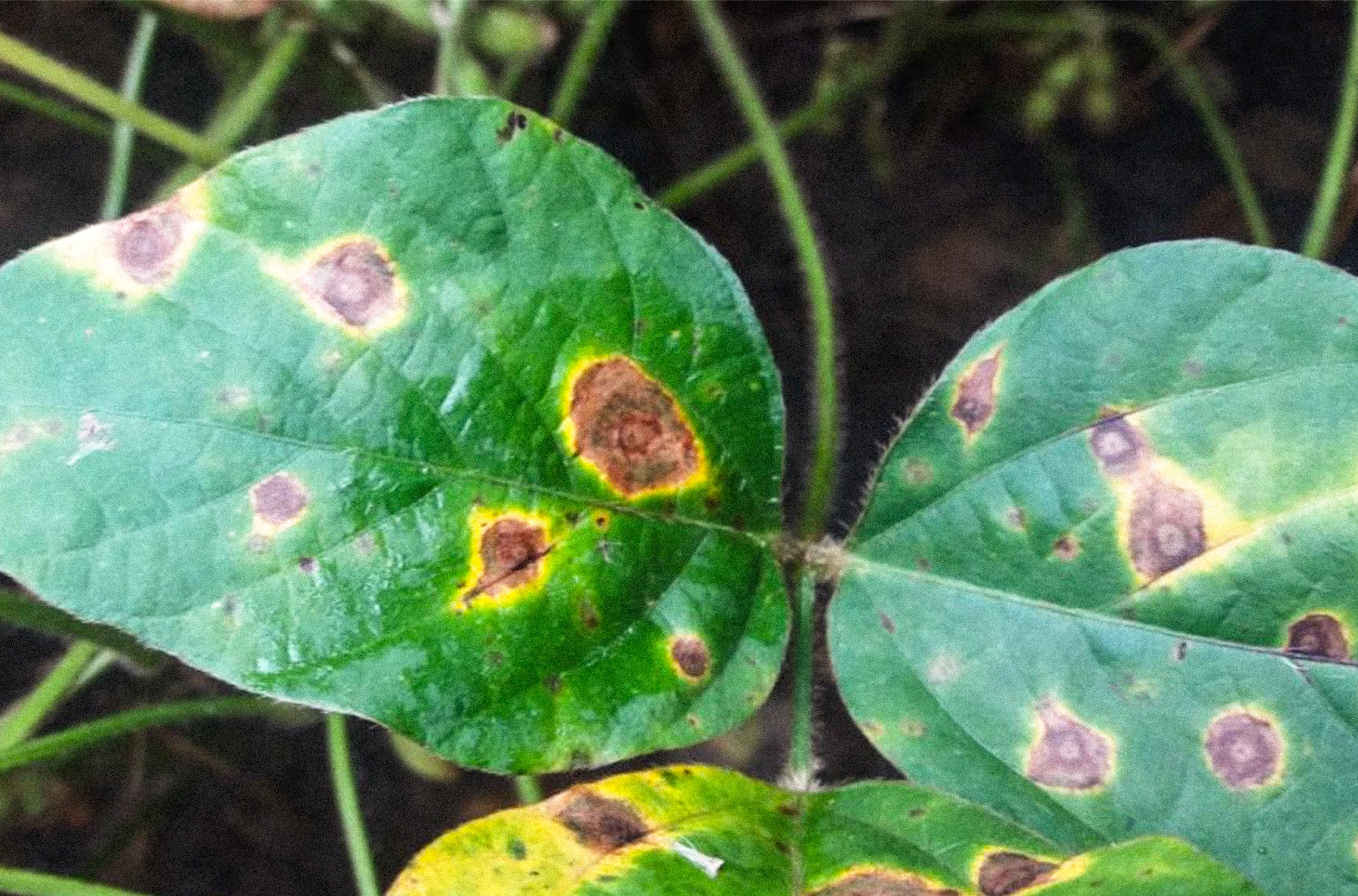
Present in more than 75% of the agricultural areas sampled in Brazil, Pratylenchus brachyurus forms neither galls nor cysts. It disappears into the middle of the field, gets mistaken for compaction or nutrient deficiency, and finds in the soybean–maize system the perfect conditions to reproduce all year round.
In 2012, researchers at Embrapa Soja mapped a commercial field in Vera, in the mid-northern region of Mato Grosso, using a 100-point sampling grid. What they found finally put a figure on the problem: losses ranged from 60 to 1,680 kg per hectare within the same field, with an average of 720 kg per hectare — 12 sixty-kilo bags, or 21% of yield potential. They also established the benchmark that is still used today: for every 82 individuals per gram of root, one bag per hectare is lost.
None of those plants showed symptoms striking enough to catch the eye from a distance.
Pratylenchus brachyurus is a migratory endoparasite. It enters the root, moves through the cortex feeding on and destroying cells of the cortical parenchyma, then exits — repeating the process elsewhere. The trail it leaves is a series of dark necrotic lesions along the root system, which is what gives the group its name: root lesion nematode.
Unlike the root-knot nematode (Meloidogyne), it does not deform the root. Unlike the soybean cyst nematode (Heterodera glycines), it leaves no visible structure in the soil. There is nothing to pull up and show.
Above ground, the symptoms are generic: smaller plants, reduced canopy, sometimes chlorotic. Embrapa Soja notes one subtle diagnostic feature — the plants are stunted but stay green. This is the kind of picture that gets attributed to compaction, to weak sandy soil, to a dry spell or to a nutrient deficiency. And it almost always is.
There is a further complication that blurs the diagnosis: the lesions open the door to secondary pathogens — Fusarium, Rhizoctonia, Verticillium. Part of the visible damage comes from the fungi that moved in afterwards. This is why Embrapa calls it "the opportunistic nematode".
The Brazilian Nematology Society (SBN) estimates the annual loss caused by nematodes in Brazil at R$ 35 billion, of which roughly R$ 16 billion in soybean alone — a figure restated in July 2026 at the National Seminar on Nematode Control, organised by the Brazilian Ministry of Agriculture together with the SBN.
On distribution, the broadest survey ever carried out in the country analysed 21,661 soil samples in the 2021 season: the genus Pratylenchus appeared in more than 75% of the areas, making it the most widespread nematode in Brazil. In Mato Grosso, an IMAmt survey of 1,799 cotton fields between 2012 and 2015 found P. brachyurus in 96.2% of them.
In Rio Grande do Sul, data from Instituto Phytus show the problem advancing: from 69% of samples between 2012 and 2014 to 72.8% in 2018.
This is the point that most undermines management in the Cerrado, and it runs against intuition.
P. brachyurus is an efficient parasite of grasses. A study by UFLA evaluated 12 maize hybrids in Sorriso and Tapurah (Mato Grosso): 11 of the 12 were classified as susceptible, with reproduction factors reaching 6.36. Only one hybrid scored below 1.
That means the sequence of soybean in the summer followed by second-crop maize — the standard system across central Brazil — gives the nematode eight to nine months of continuous reproduction per year. What is called rotation is, for this species, a succession of hosts.
Brachiaria, which many growers use as a cover crop precisely with nematode management in mind, also multiplies P. brachyurus. In an Embrapa trial in Vera (Mato Grosso) in the 2012/13 season, plots following B. ruziziensis and B. brizantha 'Marandu' carried 300 to 500 nematodes per gram of root in the subsequent soybean crop, against 50 to 100 in plots following Crotalaria or pearl millet. Yield followed the same pattern: 1,800 to 2,200 kg/ha after brachiaria, against 3,000 to 3,200 kg/ha after Crotalaria spectabilis or pearl millet 'ADR 300'.
The gap reaches 23 bags per hectare.
Beware of a piece of misinformation in circulation: some technical material classifies brachiaria as a non-host of P. brachyurus. That holds for the reniform nematode and for Meloidogyne, not for the root lesion nematode. The only exception documented by Embrapa is Brachiaria humidicola cv. BRS Tupi, released specifically as a rotation tool for this species — and which, according to Embrapa itself, is not suited to crop–livestock integration systems.
There is no soybean cultivar resistant to Pratylenchus brachyurus in Brazil. This is settled technical consensus, held by Embrapa Soja since Technical Circular 76 and reaffirmed in recent literature — in a study published in Ciência Rural in 2025, the cultivar that performed favourably was described as tolerant, not resistant.
The distinction is not a matter of wording:
The practical consequence is harsh: a merely tolerant cultivar holds yield for that season and hands the following crop a more heavily infested field. Tolerance buys relief for one season; it does not fix the system.
For scale: soybean has an RF between 8.7 and 11.9. Crotalaria spectabilis, between 0.0 and 0.3. The criterion, established by Oostenbrink in 1966 and still in use, is straightforward — an RF of 1 or above indicates a good host; below 1, a poor host.
What does exist on the market, legitimately, are tolerant cultivars and cultivars with a lower reproduction factor. When field material states "low RF for Pratylenchus brachyurus", it is using the correct term. A promise of "resistance" to this nematode in soybean is at odds with Embrapa.
Precisely because there is no genetic resistance, rotation with poor hosts is the central method — not a supporting one.
As part of its strategies for managing *Pratylenchus brachyurus*, Genética Pampeana has been evaluating the performance of its cultivars under high nematode pressure conditions. In a trial conducted by Science Nema, Lenda IPRO and Indiara IPRO were subjected to populations of 1,000, 5,000, and 10,000 specimens per plant.
The results demonstrated better root performance of Lenda and Indiara compared to the reference cultivar 8.0, reinforcing the potential of these cultivars as part of an integrated management strategy in areas with nematode occurrence. Genetics that delivers productivity, but also answers to real field challenges.