Fungicides, application technology and cultural management remain essential. But with a disease whose chemical control has limits, choosing the cultivar becomes a strategic decision. In Campo Novo do Parecis (MT), Lenda IPRO stood out in a trial of 50 cultivars, showing one of the lowest incidences of target spot among the materials assessed.
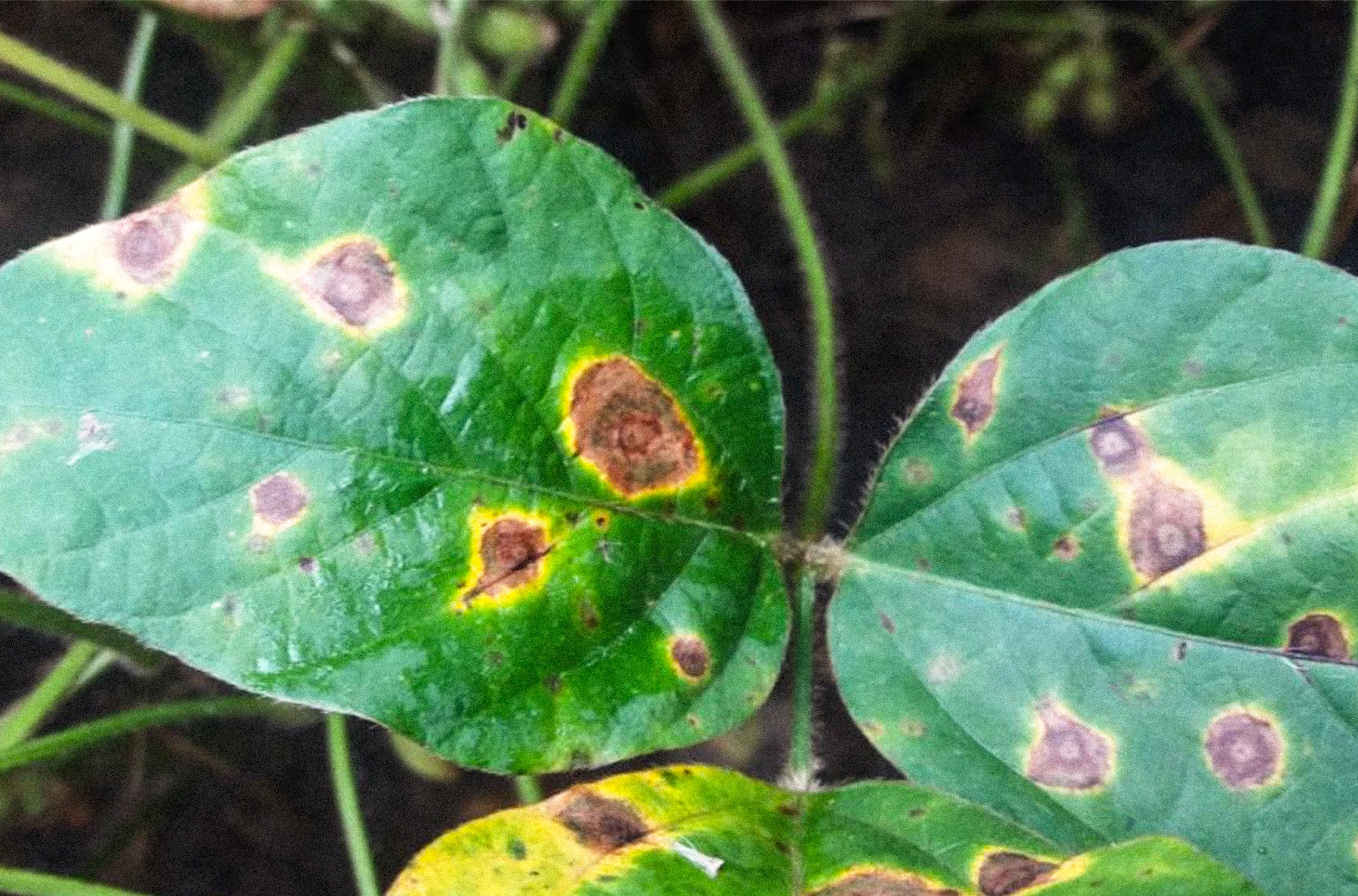
Target spot, caused by Corynespora cassiicola, stopped being a secondary soybean disease long ago. Today it is part of routine management in major producing regions, especially the Cerrado and the Matopiba.
The problem is that no single tool can solve the disease. Fungicides play a key role, but results from research networks show that chemical control has a ceiling. At the same time, environmental conditions, plant architecture, spray coverage, crop residue and genetic susceptibility all directly affect how the disease develops.
That is exactly why the cultivar has to be part of the equation.
In susceptible cultivars, target spot can cause heavy defoliation and significantly compromise yield potential.
Work carried out over recent years shows a direct relationship between rising severity and falling yield. The greater the leaf area affected, the less able the plant is to sustain grain fill.
In practice, this means that every advance of the disease that is prevented represents photosynthetic area preserved and greater protection for the crop's yield potential.
For this reason, the aim of management should not be to look for a single solution, but to build different barriers that make it harder for C. cassiicola to advance.
In recent seasons, the best fungicide programmes assessed in research networks came close to 70% control of the disease.
In addition, loss of sensitivity of C. cassiicola to different fungicide groups is already documented in Brazil, reinforcing the importance of rotating modes of action, using multi-site products and preserving the technologies available.
Another challenge lies in the very place where the disease starts.
Target spot usually develops first in the lower third of the plant, precisely one of the hardest areas to reach with a spray once the canopy has closed.
The denser the lower canopy, the harder it is for droplets to penetrate and the more a microclimate favourable to the disease builds up, with shading and retained humidity.
This explains the importance of factors such as plant population, row spacing, cultivar architecture and starting the fungicide programme at the right time.
There is currently no commercial soybean cultivar that is fully resistant to target spot.
What exists is a gradient of reaction among cultivars.
Some materials are more susceptible, while others manage to keep disease levels lower under certain environmental conditions and pathogen pressure.
And that difference is where an important opportunity lies for the grower.
In practice, choosing a material that performs better against the disease means adding one more safety margin to the management programme.
That is exactly what stood out in a trial carried out in Campo Novo do Parecis, Mato Grosso, by SoloNorte.
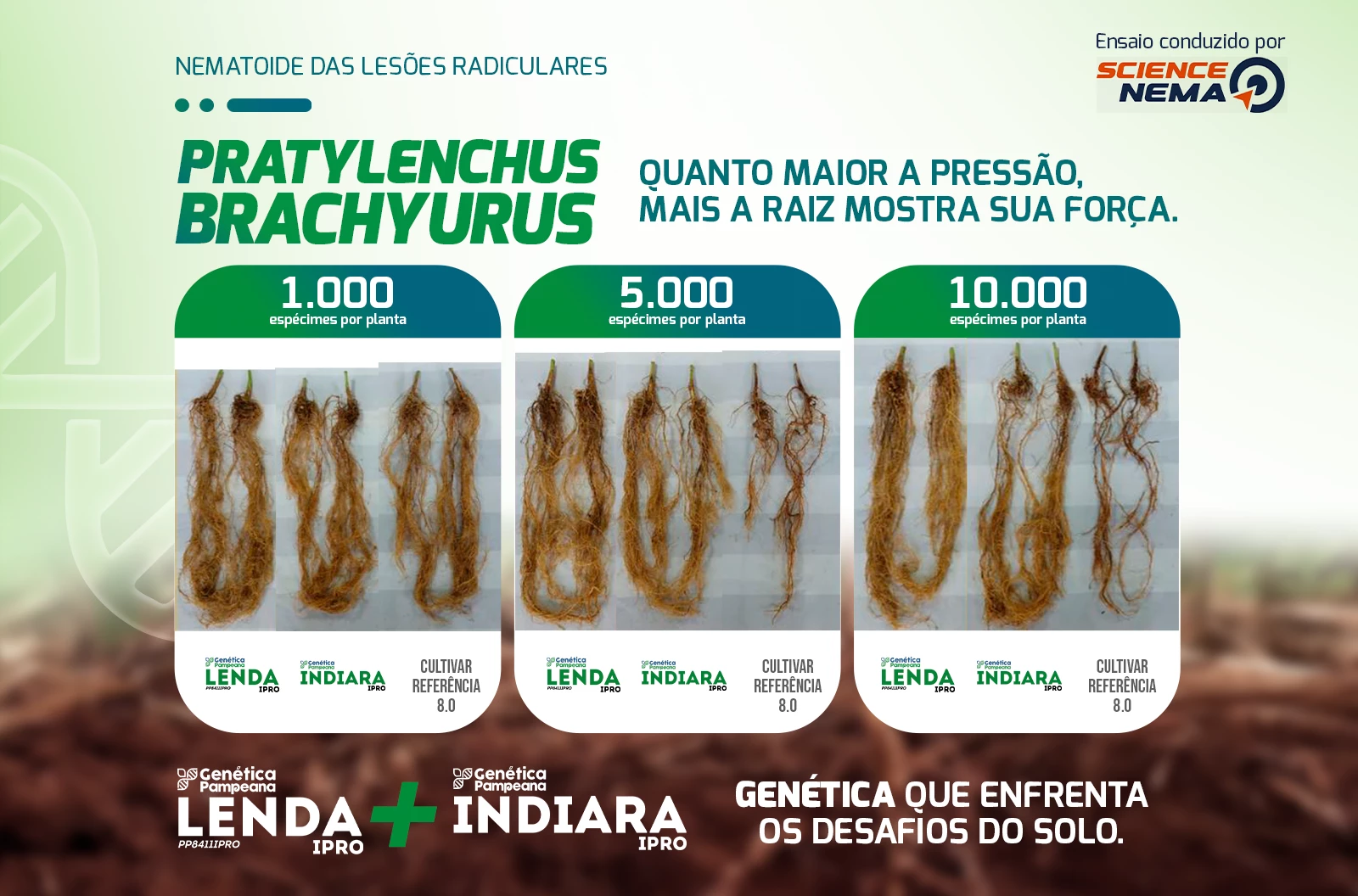
In an assessment covering 50 soybean cultivars, Genética Pampeana's Lenda IPRO was among the materials with the lowest incidence of target spot.
The result is all the more relevant because it was obtained in a region where the disease is a recurring concern for growers.
More than an isolated figure, the behaviour observed in the field reinforces a strategic trait of the cultivar: its ability to fit into production systems in which stability and plant health need to go hand in hand with yield.
This does not mean doing without fungicides or any other management tool.
It means exactly the opposite: using a cultivar that performs better as part of a complete system, allowing every other tool to work in more favourable conditions.
Target spot management begins long before the sprayer enters the field.
The main measures include seed treatment, crop rotation, crop residue management, control of host plants, adjusting plant arrangement, attention to canopy architecture and starting the fungicide programme before the disease moves up into the upper parts of the plant.
The cultivar is part of that same planning.
In the Genética Pampeana portfolio, different materials allow placement according to environment, maturity, sowing date and disease pressure. Cultivars such as Brutus IPRO, for example, have architecture that favours fungicide management, while other materials bring different agronomic traits that can be exploited in the placement for each farm.
But when it comes to target spot, the result obtained by Lenda IPRO in Mato Grosso puts the cultivar in the spotlight.
When no tool delivers 100% control, the result comes from adding them together.
Seed treatment reduces one route of entry for the pathogen. Rotation helps lower inoculum. Good plant arrangement improves the environment inside the canopy. Application technology increases the chance of the spray reaching the lower canopy. Fungicide slows the advance of the disease.
And genetics can add one more layer of protection to the system.
For growers who live with target spot, especially in high-pressure regions, the result of Lenda IPRO among 50 cultivars assessed in Campo Novo do Parecis (MT) provides objective information for planning the next season:
choosing the cultivar can also start management before the soybean even emerges.