The tolerated loss is one bag per hectare. The Brazilian average is twice that. And when rain falls on a crop that is ready, what drops to the ground is only the visible part of the bill.
In February 2026, Aprosoja recorded more than thirty consecutive days of rain in Mato Grosso, with accumulated totals above 500 mm in several regions. In the last fields harvested, losses reached 25%, with damage estimated at around R$ 1,800 per hectare in the Marcelândia area. Field reports were always the same: soybean sprouting inside the pod, moisture above standard, and rising discounts for damaged grain.
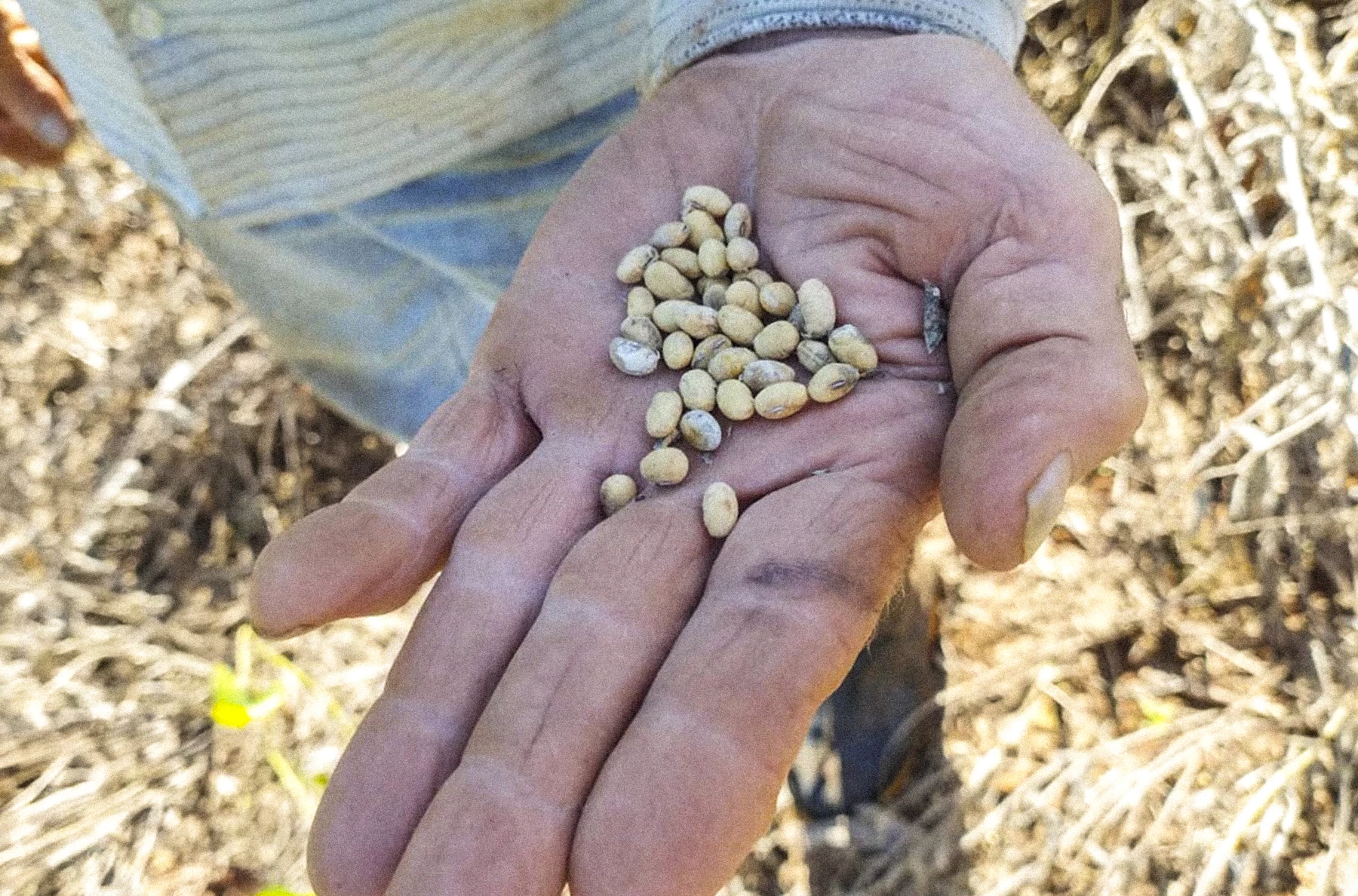
Embrapa considers it acceptable to lose up to one 60-kg bag per hectare at harvest. Surveys show the real average across Brazilian fields is around two bags, and that 61% of the properties assessed operate above the tolerance.
About 80% of that loss happens at the cutting platform — not in the combine's internal mechanisms. That is where machine setup either pays for itself or costs money.
Measuring it is simple and takes minutes. Embrapa's official method uses a 2 m² frame (4.0 m × 0.5 m) placed behind the combine, with at least three repetitions per machine. The collected grain goes into the measuring cup, which reads directly from 0 to 11 bags per hectare — no counting grains, no arithmetic. Recommended working speed: 4 to 6.5 km/h.
This is the loss that does not show up in the field, but at the scale.
Soybean classification in Brazil follows Normative Instruction 11/2007 of the Ministry of Agriculture. Grain that has germinated in the pod counts as "damaged" — together with heat-damaged, mouldy, fermented and burnt grain. The limits are tight:
Defect Type 1 Type 2 Damaged (total) 8.0% 15.0% Heat-damaged + burnt 2.0% 4.0% Mouldy 1.0% 1.0%Harvesting at the right moment helps on both fronts. The recommended range is 13% to 15% moisture. Below 12%, the grain becomes brittle and cracking and breakage increase. Above 15%, it turns plastic and suffers crushing and abrasion during threshing — damage that only shows up later.
For anyone producing seed, this is where rain charges the highest price.
Repeated wetting and drying has a technical name: moisture deterioration. Seed that has already matured, still on the plant, goes through alternating cycles of high and low humidity. The seed coat expands and contracts, cell membranes degrade, and the resulting ruptures open the way for Phomopsis, Fusarium and Colletotrichum. The visual sign is wrinkling of the cotyledon, on the side opposite the hilum.
The effect is measurable. In a study by UFSM comparing harvest at R8 with harvest fifteen days later, one cultivar fell from 98.75% to 74.5% germination — and vigour, from 99% to 71.75%. The other cultivar assessed fell much less, from 93.25% to 82.75%.
The difference between the two matters: the minimum legal standard for soybean seed in categories C1, C2, S1 and S2 is 80% germination. The first cultivar would have failed. The second would have passed by a margin.
Combine setup and speed help control mechanical losses. But when the problem comes from the weather, the strategy starts earlier: in crop planning and in the choice of cultivar.
This is precisely where Indiara IPRO stands out. Among its distinguishing traits is its excellent tolerance to rain at harvest — a characteristic that matters especially in regions where rainy spells can coincide with soybean maturity and delay getting the machines into the field.
That tolerance gives the grower an extra margin of safety when the harvest window tightens. After all, it is not always possible to bring in the whole crop at the ideal point before the rain arrives. Having a cultivar in the plan that is better able to withstand that condition helps reduce exposure to quality losses in the field.
Planning can be further strengthened by staggering sowing and using cultivars from different maturity groups. The Genética Pampeana portfolio offers options across several maturity groups, allowing placement to be adjusted to the environment, sowing date and harvest strategy.
No cultivar removes the risks of a prolonged run of rain, and harvesting at the right moment remains essential. But when the weather does not allow the plan to be followed to the letter, traits such as Indiara IPRO's tolerance to rain at harvest can make a difference inside the farm gate.